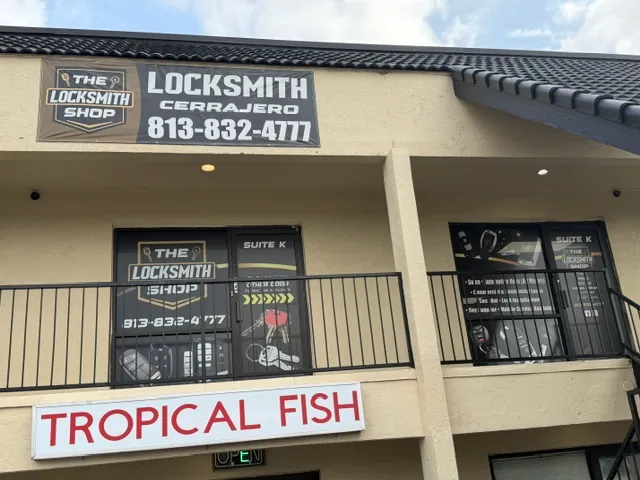
Can You Lock an Exit Door? Panic Bars & Fire Code in Tampa
Yes, against people coming in. What Florida's codes protect is the way out: under the Florida Building Code, an exit has to open from the inside “without the use of a key or special knowledge or effort,” in no more than one operation (sections 1010.2 and 1010.2.1).
By The Locksmith Shop, South Tampa ·
The short answer
- Outside: an exit can generally be locked against people coming in.
- Inside: it must open without a key or special knowledge, in one operation, with a few narrow exceptions.
- Panic hardware: the building code requires it where assembly or educational rooms hold 50 or more, plus high-hazard spaces and certain equipment rooms.
- Never: chains or padlocks, and slide bolts only on the inactive leaf of some door pairs.
A locksmith's plain-English summary as of October 2026, not legal advice.
Which codes apply?
The Florida Building Code covers construction and alterations; fire inspectors enforce the Florida Fire Prevention Code, built on NFPA 1 and NFPA 101, the Life Safety Code. Both 8th Editions took effect December 31, 2023, and conflicts are resolved in favor of the requirement offering the greatest degree of life safety (Fla. Stat. 553.73). New editions are scheduled for December 31, 2026, still proposed as of October 2026.
When is panic hardware required?
Under section 1010.2.9, swinging doors serving Group H (high-hazard) spaces, or rooms or spaces with an occupant load of 50 or more in Group A (assembly) or E (educational), may have no latch or lock “other than panic hardware or fire exit hardware.” Refrigeration machinery rooms over 1,000 square feet and certain electrical rooms need it too. Restaurants, bars and nightclubs are Group A-2, places of religious worship A-3, and an assembly building or tenant space under 50 is Group B (303.1.1).
Under the building code, offices, stores and warehouses need it only in those special rooms or in a part of the building classed as assembly, though your fire marshal may require more. Assembly rooms post their occupant load near the main exit (1004.9); the building official decides your group. Panic hardware must be UL 305 listed, span at least half the door's width and unlatch with 15 pounds or less (1010.2.9.3).
| Group | Panic hardware | Key-locked main door | Delayed egress |
|---|---|---|---|
| Assembly (A)Restaurants, bars, churches | Yes, 50 or more | If 300 or less* | No |
| Business (B)Offices, assembly under 50 | Special rooms only | Yes | Yes† |
| Mercantile (M)Stores | Special rooms only | Yes | Yes† |
| Storage (S)Warehouses | Special rooms only | Yes | Yes† |
| Educational (E)Schools, some day cares | Yes, 50 or more | No | 10 or fewer† |
*Building occupant load; places of religious worship at any size. †Only in a fully sprinklered building or one with approved smoke or heat detection.
Legal ways to secure an exit
Lock the outside, not the inside
NFPA's explainer on egress locking: “To prevent unauthorized entry, door assemblies are generally permitted to be locked from the non-egress side” ( NFPA), and OSHA allows the same at work. On a panic bar door, the outside trim decides who gets in: a key cylinder, a lever with a key, or a pull. Key the cylinder to your other doors or a master key system.
A key-locked main door, with the sign
Group A buildings with an occupant load of 300 or less, Groups B, F, M and S, and places of religious worship may fit the main door or doors with a lock that takes a key from inside (1010.2.4, item 3) if the lock is readily distinguishable as locked and an inside sign on or beside the door reads THIS DOOR TO REMAIN UNLOCKED WHEN THIS SPACE IS OCCUPIED in 1-inch letters on a contrasting background. The building official can revoke it, and day cares and schools classified as Group E or I-4 can't use it. It's the building-code rule that can allow an inside key cylinder on a storefront hookbolt lock.
Delayed egress
NFPA says delayed-egress locks are “commonly installed where there are concerns for internal security, such as theft from a store.” They're allowed for Groups B, F, I, M, R, S and U, only in fully sprinklered buildings or ones with approved smoke or heat detection (1010.2.13), so not in assembly spaces like restaurants, bars and churches. Pushing for no more than 3 seconds must start an irreversible process that frees the door within 15 seconds (30 where approved), with an alarm and the sign PUSH UNTIL ALARM SOUNDS. DOOR CAN BE OPENED IN 15 SECONDS. Sprinklers, fire detection or a power failure must release it too.
Keypads, card readers and electric locks
Readers go on the entry side (see keypad, card and fob entry): NFPA notes the no-key rule “also prohibits doors being locked via a keypad or card reader on the egress side without additional protection measures.” For electric locks, the code's options include door hardware that cuts the lock's power when used (1010.2.11, any group but H) and a sensor plus a PUSH TO EXIT button within 5 feet (1010.2.12, not in warehouses or factories); both must unlock on power loss and be UL 294 listed.
Exit alarms
An alarm can report an opening; it can't be what holds the door shut. Exit route doors “must be free of any device or alarm that could restrict emergency use of the exit route if the device or alarm fails” (29 CFR 1910.36(d)(2)).
Dogging and fire doors
Dogging holds the latch retracted so the door runs push-pull while you're open. A fire door needs “an active latch bolt that will secure the door when it is closed” ( 716.5.9.1), so its exit device isn't set to stay unlatched. Check the door edge and frame for a rating label.
Chains, padlocks and slide bolts
The code doesn't ban chains or padlocks by name; it doesn't need to. Either one means getting out takes a key or extra steps, which 1010.2 rules out, and 1010.2.1 says “manual bolts are not permitted,” meaning bolts slid by hand (chapter 2), such as surface, slide and barrel bolts. Table 1010.2.4 makes narrow exceptions for the inactive leaf of some door pairs. Exit routes must also stay “free and unobstructed” (29 CFR 1910.37(a)(3)), and exit doors can't carry mirrors or hide behind curtains or decorations (1010.1).
A monthly exit-door check
Walk every exit once a month. It doesn't replace any inspection your fire marshal requires.
The hardware
- One push releases the door, and the bar springs back.
- Outside trim and key work, so nobody props the door.
- Closing on its own, the door latches every time.
- The closer doesn't slam, drift or leak, and the door doesn't drag.
Around the door
- Dogging is undone at closing.
- No chain, padlock, bolt or wedge; nothing stacked in front.
- Required signs and the posted occupant load are up.
Trouble often starts with the door itself; see door closer repair and panic bar repair.
Who inspects exits in Tampa?
Local fire officials enforce the fire code (Fla. Stat. 633.208):
- Inside Tampa city limits: the City of Tampa Fire Marshal's Office, (813) 274-7000. Its Existing Inspections Division does periodic inspections of commercial occupancies and takes requests and complaints.
- Unincorporated Hillsborough: the Hillsborough County Fire Rescue Fire Marshal's Office. Call (813) 744-5541, Monday through Friday, 8 AM to 3 PM, to schedule an inspection.
- Another city: that city's fire department.
- Building-code questions: your local building department.
Historic Ybor bars and restaurants
In Ybor's bars, clubs and restaurants, doors serving 50 or more must swing in the direction of exit travel (1010.1.2.1), and a patio or rooftop that exits back through the building can lock its exit access doors against the people on it only under 1010.2.4, item 8: a posted outdoor occupant load of 300 or less, a weatherproof phone or two-way system, a window of at least 5 square feet, a key lock that shows it's locked, and the sign THIS DOOR TO REMAIN UNLOCKED WHEN THE OUTDOOR AREA IS OCCUPIED. Older buildings follow the Life Safety Code's existing-occupancy chapters, but no remodel may cut exits below code (1001.2). See our Ybor City locksmith page.
What The Locksmith Shop does
We handle the hardware; your fire marshal and building official decide what the doors need. We repair, adjust, replace and install rim and vertical-rod panic bars after checking the door, key outside cylinders to your other doors or a master system (Mul-T-Lock restricted keys included), fix or set up dogging where the device allows, keep fire-rated doors on listed hardware, service closers and storefront locks, and install keypad, card and fob entry, testing every exit from both sides.
Quotes are free. Family-owned since 2009, we're licensed and insured, and our bonded, background-checked techs speak English or Spanish.
Frequently Asked Questions
Is it legal to lock an emergency exit door?
From the outside, generally yes. From the inside, it must open without a key or special knowledge, in one operation, apart from narrow options in Florida's building code: a key-locked main door that stays unlocked while the space is occupied, delayed egress, and electric locks. Chains and padlocks never qualify.
Does my restaurant need panic bars?
If a dining room or bar area holds an occupant load of 50 or more, its swinging doors generally need panic or fire exit hardware (section 1010.2.9), though the main exit may key-lock instead, with the required sign, if the building's occupant load is 300 or less. Ask your fire marshal.
Does a “This door to remain unlocked” sign make a key-locked door legal?
Not by itself. The sign is one of three conditions in section 1010.2.4, item 3; the permission covers only the main door or doors in the listed occupancies, and the building official can revoke it. Day cares and schools classified as Group E or I-4 can't use it.
Can a bar put a delayed-egress lock on its back door?
Not under the assembly rules: Group A, which covers restaurants, bars, nightclubs and places of religious worship, isn't on the delayed-egress list (section 1010.2.13). For theft or break-ins, secure the outside: trim, cylinder and key control.
Can a panic bar on a fire door be dogged?
A fire door has to latch every time it closes (section 716.5.9.1), so its exit device isn't set to stay unlatched. Other doors can usually be dogged where the device allows it.
Sources
Checked October 2026 (building code text via UpCodes' reproduction). Your fire marshal has the final say.
- Florida Building Code, 8th Edition: chapter 10, chapter 7, chapter 3, chapter 2; Florida Building Commission
- Florida Fire Prevention Code (State Fire Marshal)
- Fla. Stat. 553.73 and 633.208
- Proposed 9th Editions: building, fire
- OSHA 1910.36 and 1910.37
- NFPA, “Permissible Egress Door Locking Arrangements” (2021)
- Tampa Fire Marshal's Office and Existing Inspections Division; Hillsborough County Fire Marshal
Exit Door Sticking or Not Latching?
Describe the door and its hardware, and bring photos. For a free quote, call (813) 832-4777 or stop by the shop on S Manhattan Ave.
Walk-ins welcome at 4556 S Manhattan Ave, Tampa, FL 33611Monday–Saturday 8am–8pm · Closed Sunday · Insured & bonded