Storefront Door Lock Repair in Tampa
Aluminum-and-glass storefront doors run on their own narrow hardware, and it wears out in its own ways. We repair and replace Adams Rite-style deadlatches, hookbolt deadlocks, paddles, and mortise cylinders, line the door back up, and rekey storefronts when staff move on.
What's Inside a Storefront Door
On a narrow-stile aluminum door, the frame around the glass is only a few inches wide, so the lock has to fit in a slim pocket inside the stile, the vertical edge of the door. The hardware made for that space is its own family, best known by the Adams Rite name:
Deadlatches
A spring latch that catches the strike every time the door closes, with a guard that keeps it from being slipped. A paddle, a push-pull, or a lever works it from each side.
Hookbolt Deadlocks
A bolt that swings out and hooks into the strike, so the door resists being pried away from the frame. It's thrown with a key from outside and a key or a thumbturn from inside.
Paddles & Pulls
The handle that works the latch. When a paddle sticks halfway or springs back slowly, the latch underneath or the linkage between them is usually worn.
Mortise Cylinders & Thumbturns
The threaded cylinder your key turns, held in by a set screw, with a key or a thumbturn on the inside. Cylinders can be rekeyed, keyed alike with your other doors, or swapped for restricted-keyway cylinders.
Why Storefront Locks Stop Working
A busy storefront entrance opens and closes all day, and narrow-stile hardware takes that wear in a small space. The usual signs: the key turns but the hookbolt won't throw all the way, the latch only catches if you pull the door tight, the paddle sticks halfway, or the key gets harder to turn.
A lot of it starts with the door, not the lock. Heavy glass doors drop over time, and Tampa's humidity and storm season make it worse. When the door sags, the bolt and latch no longer meet the strike, and new hardware won't change that: put a new lock in a door that has dropped and the problem comes right back. So we check the alignment first and fix the door along with the lock.
We keep Adams Rite-style deadlatches, hookbolts, paddles and compatible mortise cylinders in stock, and we match the backset (how far the cylinder sits from the door's edge) and the cutouts already in your door. If the door slams or stops short of the latch, the closer may be part of the problem: see door closer repair.
Rekeying a Storefront After Staff Turnover
When a manager or employee leaves with a key, the front door is the first lock to deal with. Rekeying the mortise cylinders makes the old keys useless and keeps your hardware. We can key the front and back doors alike, or build different access levels into a master key system with a keying chart you keep.
If keys keep walking out the door, consider restricted keyways. We're an authorized Mul-T-Lock and Medeco dealer. A hardware store or kiosk has no blank to copy a restricted key onto, so new keys go through an authorized dealer, for the people you approve; our guide to high-security locks explains how that works. Rather not hand out keys at all? A keypad or card reader on the staff entrance may suit you better: see commercial access control.
A Key on the Inside, or a Thumbturn?
Some storefronts have a key cylinder on both sides of the hookbolt deadlock; others have a key outside and a thumbturn inside. Either way, people have to be able to get out. OSHA's rule for exit route doors is that employees “must be able to open an exit route door from the inside at all times without keys, tools, or special knowledge” ( OSHA, 29 CFR 1910.36(d)(1)). So on an exit with a key cylinder on the inside, the deadlock can't be locked with that key while anyone is working inside, and whether a key-inside lock is allowed on your door at all is up to your fire marshal or building official. We ask how the door is used before we change it.
The hardware matters for customers too. If the entrance is on an accessible route, the 2010 ADA Standards hold its door hardware to section 309.4, where operable parts “shall be operable with one hand and shall not require tight grasping, pinching, or twisting of the wrist” (2010 ADA Standards, 309.4), and they put those operable parts between 34 and 48 inches above the floor (404.2.7). We keep both in mind when we choose paddles, pulls, and inside hardware. For a rear exit with a push bar, see panic bar repair.
Talk It Through at the Shop, Fixed at Your Door
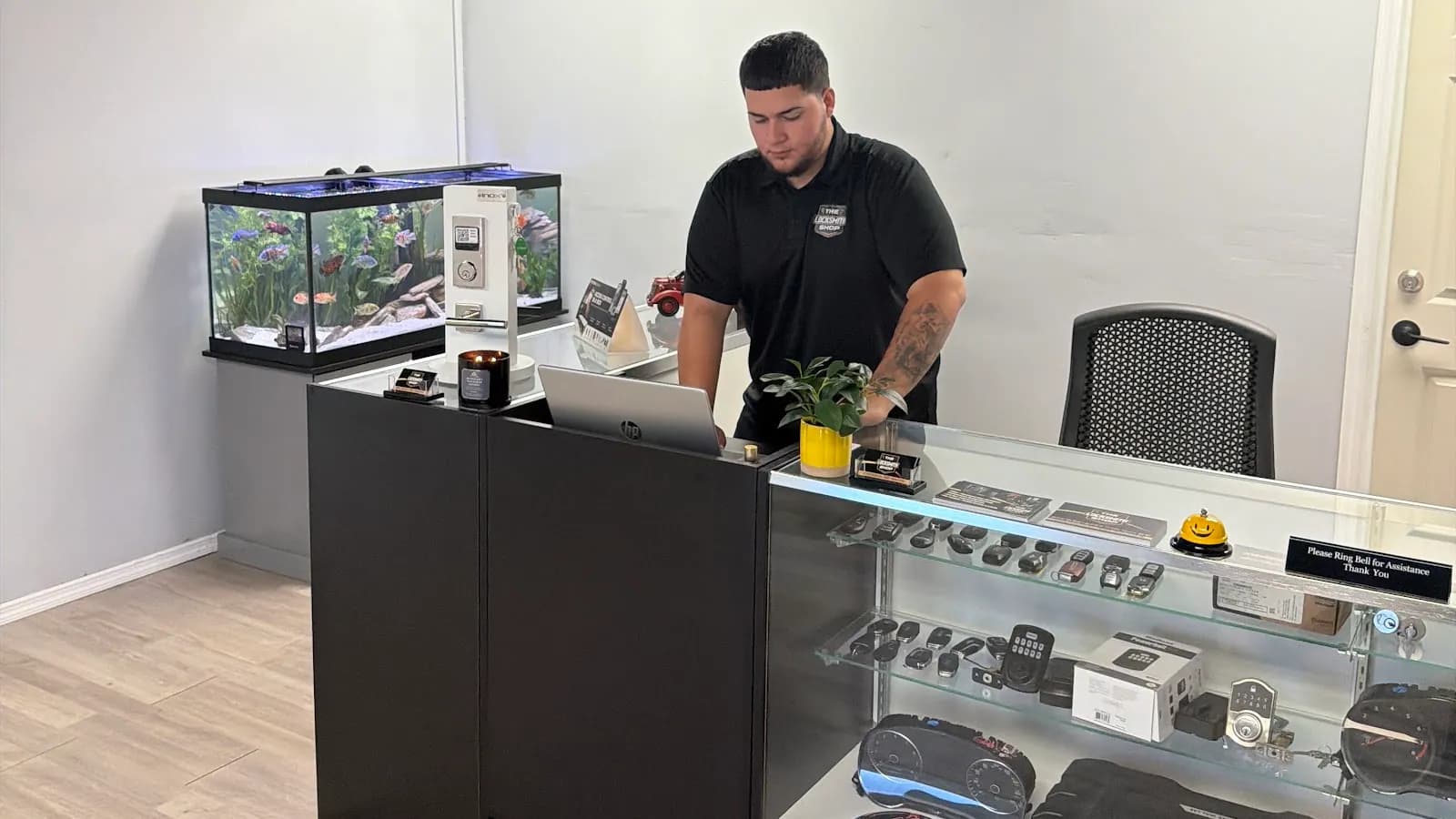
Walk in to our shop at 4556 S Manhattan Ave, Tampa, FL 33611, Monday through Saturday, 8am to 8pm, with photos of the door, both sides of the lock, and the edge of the door where the bolt comes out. Storefront work is done on-site across Hillsborough and Pinellas, from Dale Mabry and Kennedy to Brandon and St. Petersburg.
The Locksmith Shop is a family-owned Tampa locksmith, in business since 2009. We're licensed and insured, our technicians are bonded and background-checked, and we work in English or Spanish. Weighing codes instead of keys? See keyless entry for homes and businesses.
How It Works
- Step 1
Photos or a Call
Call (813) 832-4777 or walk in with photos of the door, both sides of the lock, and the edge of the door.
- Step 2
Free Quote First
Repair, rekey, or new hardware: you see the price before any work begins, and the quote is free.
- Step 3
Door First, Then Lock
We check the door's alignment, then repair, rekey, or replace the hardware to fit the door.
- Step 4
Tested and Keyed
Every lock is tested with the door closed, and every key is tried in its cylinders before we leave.
Storefront Lock Acting Up?
Tell us what the lock does when you turn the key; photos of both sides of the door help. A real locksmith answers Monday through Saturday, 8am to 8pm, and the quote is free.
Call (813) 832-4777Storefront Door Lock Questions
Can you replace an Adams Rite lock on our storefront door?+
Yes. We match the replacement deadlatch, hookbolt or cylinder to the backset and cutouts already in your door, using Adams Rite-style hardware made for narrow-stile aluminum doors, and we fix the door's alignment if it has dropped.
The key turns, but the storefront won't lock. What's wrong?+
Usually the hookbolt isn't meeting the strike, often because the door has dropped, or the deadlock or the cylinder's cam is worn. Forcing the key can snap it or damage the cylinder, so call before it fails completely.
Do we need new locks after an employee leaves?+
Usually not. Rekeying the cylinders makes the old keys useless and keeps your hardware. If keys keep disappearing, Mul-T-Lock or Medeco restricted keyways stop copies at hardware stores and kiosks.
Can our front and back doors use the same key?+
Yes, as long as the cylinders share a keyway. If they don't, we swap a cylinder so they do. Managers can also carry a master key that opens more doors than the staff keys do.
Should our storefront have a key on the inside or a thumbturn?+
It depends on how the space is used and on what your fire marshal and building official allow. One rule holds either way: employees must be able to open an exit door from the inside without a key (OSHA, 29 CFR 1910.36), so a key-inside lock on an exit can't be locked with the key while anyone is working inside. We talk through how the door is used before we change it.
We're locked out of the storefront. Can you get us in?+
Yes, Monday through Saturday, 8am to 8pm. We open it without damage whenever we can; drilling is the last option, not the first. Call (813) 832-4777.
How much does storefront lock repair cost?+
It depends on the hardware in your door (a deadlatch, hookbolt, paddle or cylinder), whether it needs an adjustment, a rekey or a replacement, and how many doors share the key. We don't post prices, but quotes are free and come before any work begins.
Related Services & Guides
Get a Free Quote
Fill out the form or call us directly for a free quote on any lock, key, or access-control job.